Supporting yourself during your studies can be necessary for some students to make up the difference between student loan and living costs. Juggling the demands of university and part-time work can be challenging but not impossible. Here’s my guide and tips for working alongside your studies.
Find a job that’s flexible
Look for roles that allows you to take shifts as and when you like them, such as agency work. I worked for an agency in hospitality during the earlier years of my degree and found it worked well given the changing timetable and demands of university work.
Try to find work that allows you to develop your dental/ medical professional skills
Dental nursing is a great part-time job for dental students as it allows you to observe procedures, work with dental materials and learn patient management skills. This is more accessible for those who have already been a dental nurse but some places take students as trainees, too.
Working in a dental technician lab also gives you a great opportunity to apply your dental knowledge and improve your manual dexterity. Working on dental-related projects gives you a chance to apply your dental knowledge – and the same goes for medicine.
Keep an eye out for opportunities sent to you by your dental or medical school which are specific for dental/ medical students.
Working as an intern at your university
Opportunities often arise for part-time work within your university. These can be great roles for students as the university usually offers flexible working hours since they know students have lots of commitments to manage.
Keep an eye out for roles within your dental or medical school for students to work as partners on projects. This allows you to utilise your expertise of the student experience and introduces you to the learning and teaching improvement processes.
Utilise the university’s Student Job hub
The university’s Student Job hub will have opportunities available to students and often these are jobs which have been selected due to their suitability to students. Here, you can also find internships both for term time and the summer.
You can also use the employability services at your university for support on CV, applications and test practice for roles.
Find evening or weekend work
Due to the demands of dental and medicine degrees, we often need to be available for university classes Monday – Friday, 9am – 5pm, so it’s a good idea to find a part-time role which won’t clash with any classes.
Reminder that all classes in dental and medical school will likely be mandatory and there are review meetings for students struggling to attend. It’s best not to jeopardise your studies by skipping classes to work.
Find remote work
Remote working offers a greater degree of flexibility than that of jobs where you’re required to work on a premise. It also reduces travel time and allows you to instead spend that time studying or working. Remote work can be done anywhere and usually is flexible hours, which would allow you to work on breaks between classes, too. Remote working also usually doesn’t require a uniform and can also save you money on buying specific clothes.
I hope these tips help you make informed choices about working part time during your studies. It can be challenging but many of us do it. Best of luck!
Written By Chelbi Hillan, Dental student at the University of Glasgow
Transitions can be daunting for most people, even more so as a care leaver who is entering dental school. I remember when I first considered applying to dental school, I was in S5 and went to take part in an access to dentistry summer school. As a young person still to find my confidence and power in my care experienced identity, attending the summer school made me feel like I couldn’t do it. The opportunity was great but I just remember feeling like “I don’t belong here”. I’m telling you this as imposter syndrome was probably one of the biggest barriers in front of me chasing my dreams to become a dentist. When I met people who spoke eloquently and boasted of their summer travels, I felt like I just wasn’t good enough to be there. This led to me leaving the summer school before it ended.
At this juncture in my life, I accepted I wasn’t going to be a dentist and pursued a career in immunology and microbiology. It wasn’t until after finishing my undergraduate and masters degree that I had the confidence to reapply. Even after becoming an accomplished young woman, still something about the prestigious reputation dentistry holds made me nervous and the feelings of self doubt returned. It takes a lot of mental reprogramming and self assurance to beat the negative thoughts and affirm that I am good enough to be on the course.
As a care experienced person applying to dentistry, the widening access team are one of the best resources you can utilise. From the moment I applied, I reached out to the team to ask for support and had a 1-1 with someone to talk about adjusted offers, money and tuition fees. The widening access team helped liaise with the dental admissions team to secure an adjusted offer, without this I wouldn’t have been able to get into dental school. Adjusted offers are not making allowances, they are offered to students who face significantly more challenge than their peers and therefore have greater difficulty in preparing for tests and applications. Adjusted offers are nothing to be ashamed of, they are made in order to recruit exceptional students in extenuating circumstances. If you are worried about people knowing you had an adjusted offer, nobody except the admissions team and widening access will have knowledge of this.
Once I received my adjustment, I was then invited to interview and offered a place on the course. I was overjoyed that after years of studying biomedical sciences, I was finally going to study dentistry. A dream come true. That is until I realised I had no money and I was unsure if I would get funding for a second degree. I had another call with the widening access team who explained the scholarships they could offer me and provided information about how to apply for the discretionary fund (care experience is a priority group at my university). This went a really long way in helping cover the costs as an independent student. If you are studying in Scotland, we have the Dental Student Support Grant (DSSG) available from second year onwards and is issued by the Scottish Government with a commitment to wok for the NHS for one year for each year the grant is awarded.
Social housing was another lifeline for me as a student studying in Glasgow city. Rent prices had increased exponentially in the city as I was about to start my degree and the house I was living was going to increase the rent by 50% just months before I was supposed to start my degree. Due to this I had to move back to my hometown and commute for a few months at the start of my degree. Thankfully, my application for social housing was accepted three months not the course and I was able to move close to the university again and this time with sustainable rent prices. Truly, if I didn’t get access to social housing it would have been impossible for me to live alone in the city so I would really encourage you to apply to registers and contact housing associations to ask if they have priority places for care leavers. If you can’t access social housing, some universities have 12 month accommodation available for care leavers and will help accommodate you moving in earlier if necessary. If you are stuck for housing, liasing with the widening access and accommodation teams can allow them to support you into suitable and sustainable accommodation.
Building strong connections during my dentistry degree was undoubtedly one of the reasons I was able to endure and push through hose hard days. Dentistry is an extremely rewarding career but its no secret that often dental professionals are burnt out. As care leavers, we may have less support than our peers so it is important you find people to fall back on when times get tough. I was lucky to find some like minded friends on my course and their unwavering support has carried me through educational and personal challenges which arose during my studies. As care leavers, we can be hyper independent as this was how we survived sometimes but relying on others allows you not only to survive but to thrive.
Another resource I have utilised many times in my education is the university counselling and support services. Many of us have complex mental health challenges and although the university counselling tends to be limited to a set amount of sessions, it was invaluable for me in times of crisis. They offer a range of services from group sessions to 1-1 counselling. Having knowledge of what is available and how to access it is important. Even if you don’t use it right away, it is good to know what is on offer for when you might need it.
Student societies can be a great way to meet other students and build a network of support. Universities have so many societies meaning there is something for everyone and even if you can’t find one you like then you can start one. Some universities even have care experienced and estranged student societies or events so look out for these. Meeting other care experienced students at university was one of the most healing experiences for me and prevented me feeling so isolated in the challenging times.
My final piece of advice is that all you have endured in your time will help you relate better to patients. Often, I find myself more able than my peers to empathise with patients about their situation. I think that having experienced many challenges in my early life as a child and young adult has made me more aware of the social factors which influence oral and systemic health. Having this deep understanding allows me to connect with patients and provide care for them through this lens of understanding.
Written by Chelbi Hillan, Dental student at the University of Glasgow
The Dental Schools Council spoke to Admissions Leads across the UK on what makes a good dental students. Here are the highlights and summaries of what universities look for in prospective students, including tips on work experience and UCAT.
You can watch the full webinar here.
What’s a key skill Admissions Teams look for in prospective students?
Professor Chris Pennington, University of Newcastle
We’re looking for people that can reflect. It’s really important that these are questions in your mind when you’re doing that. When you observe or volunteer, ask yourself: What would be challenging about that role? What would help me handle it? How do my skills fit, and what would I need to develop? Reflection like that really stands out.
Juliet Kendall, University of Manchester
It’s not just about picking out those academic high-flyers. We’re looking for softer skills – empathy, resilience, compassion – the values that make someone a good dentist. Applicants need to show reflection and awareness of their own strengths and areas to develop.
What work experience do dental schools look for?
Professor Chris Pennington, University of Newcastle
We used to call it ‘work experience’ but what matters is career exploration – understanding what the profession involves, both the good parts and the hard parts. We want applicants who have thought about what suits them and what might be challenging.
Professor Chris Pennington, University of Newcastle
You want lots of experience of human interaction. Jobs like waiting tables or tutoring give real transferable skills, such as teamwork, handling complaints and communication. We look for applicants who recognise that.
What are alternatives to clinical work experience?
Professor Chris Pennington, University of Newcastle
We no longer reward prestigious work experience as we know some people find it far easier to secure that work experience. There are other alternatives as well. A wonderful course is Sheffield’s Discover Dentistry course. You can also listen to podcasts, articles, talk to people in healthcare and read up trusted online content. There are many ways to explore the career.
When do students start to have practical, hands-on experience?
Ewen McColl, University of Plymouth
Students are very practically involved from early on. They’ll need to use their skills in an environment with patients who sometimes struggle to access dental care. In our school, students work across the South West – in community clinics and hospitals – and it’s not unusual for them to treat a child who needs multiple extractions under general anaesthetic. It’s real hands-on learning from the start.
What’s a recent success of a dental student supporting patients?
Ewen McColl, University of Plymouth
One of our students picked up signs of oral cancer in a patient – a squamous cell carcinoma. Dentistry is about understanding biology and pathology and applying it to real lives.
What’s your advice for managing nerves at an interview?
Professor Chris Pennington, University of Newcastle
Everyone’s nervous at interview. We don’t penalise that. If you need to pause, take a sip of water, ask to repeat the question – that’s fine. We expect nerves.
UCAT explained
Juliet Kendall, University of Manchester
Ultimately, UCAT is a test people have to practise. You can’t really study for it but you can practise. All the info is available on the UCAT website. There are lots of resources there. Universities are looking for people with empathy, resilience, compassion, we hope the test picks out some of these skills.
Why do dental schools value diversity in their cohorts?
Professor Chris Pennington, University of Newcastle
As dental professionals, we serve people from all communities and all backgrounds. We need to know how best to meet their needs, including the ones we might not even see yet.
Having students from varied backgrounds gives us new perspectives, helps us solve complex problems and makes us stronger as a profession. For example, after Black Lives Matter, some of our black students pointed out that we had no images of healthy black gums in our teaching. We hadn’t realised that gap until they raised it and it led us to change our curriculum.
People who come from less well-represented groups bring insights into their own communities, highlight what we’re missing and help us care better for everyone.
You can watch the full webinar on the Medical Schools Council YouTube channel.
A strategic application is one of the most important ways to maximise your chances of getting into medical or dental school. Having a perfect application isn’t necessary – where you apply to can matter more. Many students miss out on a place in medical school not because they didn’t do well enough in their exams or the UCAT but because they didn’t apply strategically and use their strengths to their advantage.
What does a strategic application mean?
Medical schools select candidates for interview based on:
- Predicted A-Level grades
- GCSE results
- UCAT score
- Sometimes, your personal statement
Medicine and Dentistry are highly competitive and not every applicant is top-performing in all areas. Fortunately, different universities prioritise different factors. This means you can apply to the schools that suit your application the best.
Top tips for strategic application
- Check widening participation (WP) points: If you qualify, explore universities that award WP points when reviewing applications.
- Meet the A-Level requirements: Some universities require A*AA, others AAA and this can vary for Graduate Entry Medicine. Check which universities match your expected or actual grades.
- Understand your strengths and weaknesses: Know where your application shines and where it doesn’t. If you have strong grades, look at universities that require this. If you did lots of work experience that developed key skills, reflect on these in your personal statement.
- Research each university’s process: Make sure to understand how different universities’ run their application process, e.g. the types of interviews they hold.
- Attend applicant open days: These provide direct insight into a university and you have to chance to ask advice from admissions teams and current students.*
- Consider all universities: Go through every medical university as some you might not have considered properly may end up becoming your first choice. Use The Medical School Council’s entry requirements tool.
First, identify your strengths and weaknesses. Then, choose universities that align with your strengths. Take your time. Don’t leave your application until last minute. It can seem overwhelming and daunting but it’s worth spending time thinking carefully. This decision can make or break your chances!
Strategy for narrowing down options
- Make a list of all UK medical schools that you meet the requirements for – use the Medical School Council’s entry requirements tool.
- Cross off universities where you don’t meet the UCAT cut-offs, if the university publishes these.
- Highlight the universities that value your strongest areas. I would advise you to look specifically on the websites of each university and published information for specific information on how they mark applicants.
- Consider non-academic factors, such as city, location, teaching style and opportunities for placements. Make sure you would enjoy the course you’re applying for.
Structuring your four UCAS choices
1st choice: A slightly risky option
You can afford to have an ambitious choice that’s still within your reach. This is a university you’d be excited to study at and willing to potentially risk a rejection. However, this still has to be in the scope of your capabilities.
Example: My weakness was my UCAT score – applying to Norwich medical school was risky for me because they didn’t have a cutoff and were more competitive than the other universities I applied to.
One risk is okay as long as the options are well thought-out and proportional to your own stats (an ambitious choice doesn’t look the same to everyone, depending on your grades and UCAT).
Note: The “competitiveness” of a university can be estimated by researching the applicant to offer ratio online.
2nd and 3rd choice: Two solid options
The 2nd and 3rd options are universities which you’ll have a very good chance of succeeding at. They match your strengths, they aren’t as competitive but they’re also places you would be happy going to.
Example: my 2nd and 3rd options were Queens university Belfast and Keele University. Belfast strongly valued good GCSEs and previous experience in the interview and Keele valued a strong personal statement, which I also had.
You may also find it useful to analyse previous UCAT score trends to try to ‘predict’ the cutoff if a university hasn’t declared one. But make sure you fall well within the predicted range if you are using this strategy as requirements can change yearly. Some universities publish their past admissions statistics on their websites and it’s also possible to analyse the scores of previous applicants from websites such as The Student Room – but use this with caution as the advice doesn’t come directly from universities).
4th choice: The backup
It’s possible not to receive offers from any of the other universities, so you need a safe option that you know you’re most likely to get into. This is the university that most strongly lines up with your strengths and it may also be much less competitive. This may not be a place you would be thrilled to study at but, given the option between the chance to study Medicine/ Dentistry and not, you would seize the opportunity.
Example: My backup option was one of the newer medical schools and my application looked extremely strong as they gave a scoring system to predict our likelihood of getting an interview. Even though I wasn’t that passionate about the city of the university, I knew I needed a safe option in case the other applications failed.
But how do you know specifically which medical schools to apply to?
It depends on your stats! The most valuable thing you can do is to look at the weighting and marking criteria that the universities use to score their applicants. You want to apply to the universities that favour the strengths you have!
But what if I don’t have my UCAT score yet?
If you’re thinking ahead of which universities to apply to, I would start visiting universities and going to open days. You can find a list on the Studying Healthcare Events page, as well as the Instagram and TikTok accounts. You get a ‘vibe’ from the city as to whether you would be happy there when you visit and loving the city you study in definitely enhances your university experience.
Make sure to keep an open mind. Before taking my UCAT, I was set on going to London or Sheffield and I was so when I realised that they were too competitive for me! The bottom line is to learn about different universities and possible options, research less competitive universities to keep an open mind and try to identify which areas of your application may be weaker early on.
Summary
- Don’t rush your choices – they could make or break whether you get a place to study Medicine or Dentistry.
- Evaluate the strengths in your application and find the universities which best compliment this.
- Don’t think about prestige too much. Medicine and Dentistry aren’t the same as applying to other degrees and you might have to apply to places much less known – but it gets you to be a doctor pr dentist the same!
- Remember that you’ll find the place you’re meant to study in and taking a gap year or resiting exams is more common than you might think!
*Applicant open days: Open days were invaluable for me. At Keele, the Admissions Lead explained exactly what they look for in a personal statement, which helped me secure an offer. At Lincoln, I spoke to the admissions officer about their scoring system, which reassured me that I was a strong applicant. Open days can also help when deciding which offer to firm.
Written by Beth Stephenson, 2nd Year Medicine student at Queen’s University Belfast
Don’t underestimate your fifth choice on your UCAS application. It’s your safety net if things don’t go to plan, even if you intend to reapply the following year. But how do you decide which course to choose alongside your four medicine or dentistry applications?
Stategies that worked for me
Strategy 1: Pick a science-related course
This is a good option if you are more interested in the science behind medicine or dentistry, and particularly enjoyed studying Biology or Chemistry at A-Level. It particularly suits students who are more research-minded.
Examples: biomedicine, pharmacy biochemistry, biology, chemistry
Strategy 2: Pick a healthcare-related course
Choose this if you are more drawn to patient interaction and the caring side of medicine or densitry. If you have enjoyed first aid or pre-hospital care, courses such as Paramedic Science could be especially appealing.
Examples: nursing, midwifery, paramedic science
Strategy 3: Choose a degree linked to a medical speciality
For example, if you are fascinated by neurology, you could apply for Neuroscience. Other examples included genetics, immunology, psychology, physiology, anatomy. This pathways works well if you already have a particular area of medicine in mind.
Strategy 4: Pick a completely unrelated course
This is a good choice if you have a strong passion outside of medicine or dentistry and would genuinely enjoy studying it further. For example, you might apply for languages, humanities subjects or non-medical STEM degrees. Some applicants can only see themselves doing medicine or something entirely different.
Transfer schemes and postgraduate medicine/ dentistry
If you’re not willing to take a year out to reapply to Medicine or Dentistry, you could choose a course which is most likely to allow you to either switch to Medicine or Dentistry, or join as a postgrad.
Transfer schemes
Some universities allow students on degrees such as biomedical science, biomed, optometry, pharmacology, neuroscience and similar to transfer into Medicine after one to three years, depending on performance. These are highly competitive and usually require excellent grades and attendance.
Postgraduate options
Another route is applying after completing a different degree. To be eligible, you normally need at least a 2:1 classification in your degree. Some graduate entry courses require science-related degrees, while others accept any subject. Instead of the UCAT, you may need to sit the GAMSAT. Graduate entry courses take four years; however, they are competitive and have limited spaces available. You can also apply to standard five-year courses as a graduate. Requirements vary – some universities still ask for A levels in chemistry and biology, while others do not.
There is also the possibility of becoming a physician associate (PA) after a life sciences or health-related degree. It then requires a 2 year postgraduate PA course to be able to work under the supervision of doctors in the NHS.
Key takeaways
- Always put down a fifth choice, even if you think you will reapply. If you don’t receive a Medicine or Dentistry offer, you may be grateful for an alternative pathway in case you change your mind.
- There are multiple ways into the profession and many people study a different degree before becoming a doctor or dentistry.
Written by Beth Stephenson, 2nd Year Medicine student at Queen’s University Belfast
Congratulations to everyone who received their A-Level results today! Whether or not you received the grades you expected, you should be really proud of yourself for coming this far. Here’s what to do next if you want to study healthcare at university:
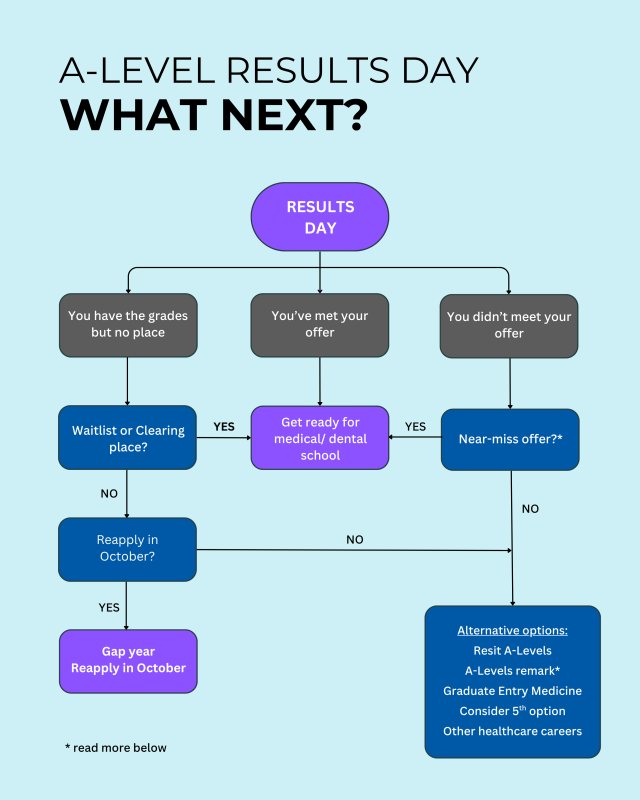
Near-miss offers
In rare cases, some universities might still accept you onto the course if you miss your offer grade by one, or two, grades. Not all universities offer this and you will be contacted if your place is eligible for a ‘near-miss’ offer.
A level re-mark
If you didn’t get the results you expected, you could ask for a re-mark (known as ‘review of marking’). Speak with your subject teacher if this is the right option for you. Remarking usually costs around £50 per exam and, if your new grade is lower, this will be final. Remarking doesn’t guarantee you’ll secure your uni place but you could re-apply next year with the grade(s) you receive.
Alternative options
Not getting the place you wanted doesn’t mean you can’t work in healthcare. You may want to comsider your fifth option subject, if you applied for a back up subject on your UCAS application. There are also many other subjects that allow you to have rewarding careers in healthcare for you to explore. Some students may also choose to re-apply as a graduate. If you choose this option, be sure to undertake a degree that is accepted by schools that offer this course, and remember it can be very competitve.
You have the grades but no place
If you managed to do better than expected, you have a few options you can try. Many schools use waitlists if a place becomes available, so make sure when completing your application you select any boxes that give schools the permission to do this. They’ll normally let you know beforehand if you have been waitlisted, so you know whether it’s an available option. You could also try to secure a place via UCAS Clearing but nite that not all medical or dental schools use this method. Alternatively, you could decide to take a Gap Year and reapply, this will give you time to build strong work experience, give you a breather after your studies and start afresh!
Reflecting on why I chose dentistry, I had always been interested in a career that combined science with patient care. While dentistry and medicine initially appealed to me, I found that the hands on nature and continuity of care in dentistry aligned more closely with my interests. I was especially motivated by the opportunity to build long term rapport with patients and make a lasting impact on their oral health and confidence.
One of the most rewarding aspects of the course was the early opportunity to work with patients in a clinical setting. This experience was invaluable in allowing me to further develop my communication skills while applying theoretical knowledge in practice and refining my manual dexterity to grow in confidence as a clinician. Building trust with anxious patients and helping them feel more comfortable was a particularly fulfilling part of my training.
One of the key skills which required implementation during the course was managing time effectively. Unlike many other degrees, dentistry requires balancing academic study with clinical responsibilities. While the workload can be quite heavy at times, with effective organisational skills, it can certainly be managed. I would recommend a planner to help prioritise tasks appropriately and stay on top of commitments. Ongoing self reflection throughout the course is paramount not only as a student but as you begin your professional career post-graduation.
For anyone considering dentistry, I strongly recommend gaining as much experience in the field as possible, through shadowing professionals, speaking with current students and reflecting on your motivations. Dentistry is an incredibly rewarding profession and those of us in the field are very privileged to be in a position to help others in such a meaningful way.
For guidance on what studying dentistry at uni is like and everything you need for your application, use our resources here.

About the author
My name is Youssef El-Wahab and I have recently graduated from King’s College London with a degree in dentistry.
The Dental Schools Council (DSC) would like to make it clear that no dental schools are affiliated with any websites selling courses and services to assist with applications to dental schools. Paid-for services allow for those with the disposable income available to access extra support which is unfair and inappropriate. Private assistance is not run by admissions professionals or academic staff and thus advice issued must be regarded with caution.
DSC does not endorse the sites and dental schools will not consider certificates from such providers when reviewing applications from prospective students. DSC encourages students to access legitimate, free and reliable admissions advice via official resources including the studying healthcare website and dental schools’ own university websites.
Students are encouraged to participate in their university’s own initiatives to help applicants instead of unaffiliated companies offering admissions advice. For those students considering engaging with private companies to sell assistance to applicants to dental school, care should be taken to not breach fitness to practise rules and student agreements with their dental school. At some schools, participation is explicitly not allowed.