Throughout your career, and even during medical school, you may need to reflect on experiences and interactions you’ve had and write about the things you learned from them – so why not get into the routine now and help increase your interview scores?
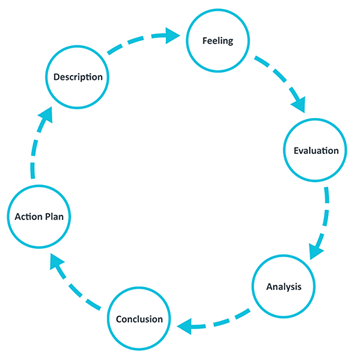
Gibb’s reflective cycle is a framework that medical students and doctors are encouraged to use to provide a holistic reflection on events, with the main emphasis being on what you learned or would do differently next time. Given that reflection is an important part of life as a doctor, providing a reflection on things like work experience in an interview could help you earn points.
How do you use Gibb’s reflective cycle?
Description: What happened? What task were you faced with or what did you observe?
Feeling: How did this interaction make you feel?
Evaluation: What was successful/unsuccessful about this experience? How did you positively/negatively contribute to the experience?
Conclusion: What did you learn from this situation? How could you have played a better part? What skills should you refine to make this better next time?
Action plan: What would you do differently? How will you action refining the skills needed to improve your role/performance?
Don’t be afraid of admitting previous mistakes to the interviewer, a doctor that can reflect on mistakes and learn from them is a far better doctor than one that doesn’t admit they are wrong!
Example 1: reflection on work experience
Description: As work experience, I shadowed a GP at a local GP clinic. A patient came in who had hypertension and shortness of breath and didn’t speak fluent English. I observed how the GP used simple language, diagrams, and hand actions to explain the condition and what could happen if the hypertension is unmanaged.
Feeling: I felt inspired by this interaction as, despite the circumstances, the GP was able to communicate effectively to the patient, and the patient seemed satisfied with the appointment.
Evaluation: I think the way that the GP utilised different communication techniques was great, and I will endeavour to do so when I am practising.
Analysis: Personally, I don’t think much could have been done differently apart from utilising the interpretation services available or even Google translate – but as the GP and patient didn’t struggle particularly to communicate eventually, I don’t think this was necessary.
Conclusion: This experience has made me aware of the struggles that non-fluent English speakers may face when accessing healthcare and this experience has inspired me to research about NHS interpreters further and think about how I can put these skills into practice.
Action plan: As a future medical student and doctor, I will ensure that I adapt my communication techniques whenever necessary, so the best patient care is achieved – such that each patient comes away from consultations feeling as though I have addressed their concerns.
Example 2: reflection on teaching
Description: While volunteering with St John’s Ambulance, I have been teaching bystander CPR in local secondary schools. During one teaching session, a group of students at the back of the class were talking, laughing and distracting their peers.
Feeling: Initially I felt embarrassed by the situation, but I took a breath then asked them politely to quieten down – then continued with the session.
Evaluation: I feel I handled the situation positively, but I could have reiterated the importance of bystander CPR training to them to ensure that they understood how severe a cardiac arrest is, and therefore how important it is that they were listening.
Analysis: I think it does make sense to initially feel embarrassed, but I am proud of how I handled the situation – by reflecting I will feel more confident in tackling issues like this next time.
Conclusion: I think I should refine my communication and teaching skills before my next session, perhaps by noting some cardiac arrest statistics so the seriousness of the teaching session will remain in student’s heads.
Action plan: As mentioned, I will note down some statistics that I can share with the students next time I am teaching. I will also preface the teaching session by outlining the behaviour I expect from the students, rather than having to address it later in the session. I think that now I have handled disruptive students once and reflected on it, I know how to approach situations like this in the future.
Reflection in interviews
Being able to reflect in such a thorough and structured way will help tackle interview questions such as ‘reflect on an experience you saw on work experience’ or ‘reflect on when you could have used teamwork skills better’ – so keep the structure in mind when answering these questions so you know you won’t miss anything out!
Useful resources

About the author
Chloe Palmer is a second year medical student at Keele University, she is passionate about improving access to medicine for students from state school backgrounds and striking the right balance between work and fun at medical school.
Supporting yourself during your studies can be necessary for some students to make up the difference between student loan and living costs. Juggling the demands of university and part-time work can be challenging but not impossible. Here’s my guide and tips for working alongside your studies.
Find a job that’s flexible
Look for roles that allows you to take shifts as and when you like them, such as agency work. I worked for an agency in hospitality during the earlier years of my degree and found it worked well given the changing timetable and demands of university work.
Try to find work that allows you to develop your dental/ medical professional skills
Dental nursing is a great part-time job for dental students as it allows you to observe procedures, work with dental materials and learn patient management skills. This is more accessible for those who have already been a dental nurse but some places take students as trainees, too.
Working in a dental technician lab also gives you a great opportunity to apply your dental knowledge and improve your manual dexterity. Working on dental-related projects gives you a chance to apply your dental knowledge – and the same goes for medicine.
Keep an eye out for opportunities sent to you by your dental or medical school which are specific for dental/ medical students.
Working as an intern at your university
Opportunities often arise for part-time work within your university. These can be great roles for students as the university usually offers flexible working hours since they know students have lots of commitments to manage.
Keep an eye out for roles within your dental or medical school for students to work as partners on projects. This allows you to utilise your expertise of the student experience and introduces you to the learning and teaching improvement processes.
Utilise the university’s Student Job hub
The university’s Student Job hub will have opportunities available to students and often these are jobs which have been selected due to their suitability to students. Here, you can also find internships both for term time and the summer.
You can also use the employability services at your university for support on CV, applications and test practice for roles.
Find evening or weekend work
Due to the demands of dental and medicine degrees, we often need to be available for university classes Monday – Friday, 9am – 5pm, so it’s a good idea to find a part-time role which won’t clash with any classes.
Reminder that all classes in dental and medical school will likely be mandatory and there are review meetings for students struggling to attend. It’s best not to jeopardise your studies by skipping classes to work.
Find remote work
Remote working offers a greater degree of flexibility than that of jobs where you’re required to work on a premise. It also reduces travel time and allows you to instead spend that time studying or working. Remote work can be done anywhere and usually is flexible hours, which would allow you to work on breaks between classes, too. Remote working also usually doesn’t require a uniform and can also save you money on buying specific clothes.
I hope these tips help you make informed choices about working part time during your studies. It can be challenging but many of us do it. Best of luck!
Written By Chelbi Hillan, Dental student at the University of Glasgow
Transitions can be daunting for most people, even more so as a care leaver who is entering dental school. I remember when I first considered applying to dental school, I was in S5 and went to take part in an access to dentistry summer school. As a young person still to find my confidence and power in my care experienced identity, attending the summer school made me feel like I couldn’t do it. The opportunity was great but I just remember feeling like “I don’t belong here”. I’m telling you this as imposter syndrome was probably one of the biggest barriers in front of me chasing my dreams to become a dentist. When I met people who spoke eloquently and boasted of their summer travels, I felt like I just wasn’t good enough to be there. This led to me leaving the summer school before it ended.
At this juncture in my life, I accepted I wasn’t going to be a dentist and pursued a career in immunology and microbiology. It wasn’t until after finishing my undergraduate and masters degree that I had the confidence to reapply. Even after becoming an accomplished young woman, still something about the prestigious reputation dentistry holds made me nervous and the feelings of self doubt returned. It takes a lot of mental reprogramming and self assurance to beat the negative thoughts and affirm that I am good enough to be on the course.
As a care experienced person applying to dentistry, the widening access team are one of the best resources you can utilise. From the moment I applied, I reached out to the team to ask for support and had a 1-1 with someone to talk about adjusted offers, money and tuition fees. The widening access team helped liaise with the dental admissions team to secure an adjusted offer, without this I wouldn’t have been able to get into dental school. Adjusted offers are not making allowances, they are offered to students who face significantly more challenge than their peers and therefore have greater difficulty in preparing for tests and applications. Adjusted offers are nothing to be ashamed of, they are made in order to recruit exceptional students in extenuating circumstances. If you are worried about people knowing you had an adjusted offer, nobody except the admissions team and widening access will have knowledge of this.
Once I received my adjustment, I was then invited to interview and offered a place on the course. I was overjoyed that after years of studying biomedical sciences, I was finally going to study dentistry. A dream come true. That is until I realised I had no money and I was unsure if I would get funding for a second degree. I had another call with the widening access team who explained the scholarships they could offer me and provided information about how to apply for the discretionary fund (care experience is a priority group at my university). This went a really long way in helping cover the costs as an independent student. If you are studying in Scotland, we have the Dental Student Support Grant (DSSG) available from second year onwards and is issued by the Scottish Government with a commitment to wok for the NHS for one year for each year the grant is awarded.
Social housing was another lifeline for me as a student studying in Glasgow city. Rent prices had increased exponentially in the city as I was about to start my degree and the house I was living was going to increase the rent by 50% just months before I was supposed to start my degree. Due to this I had to move back to my hometown and commute for a few months at the start of my degree. Thankfully, my application for social housing was accepted three months not the course and I was able to move close to the university again and this time with sustainable rent prices. Truly, if I didn’t get access to social housing it would have been impossible for me to live alone in the city so I would really encourage you to apply to registers and contact housing associations to ask if they have priority places for care leavers. If you can’t access social housing, some universities have 12 month accommodation available for care leavers and will help accommodate you moving in earlier if necessary. If you are stuck for housing, liasing with the widening access and accommodation teams can allow them to support you into suitable and sustainable accommodation.
Building strong connections during my dentistry degree was undoubtedly one of the reasons I was able to endure and push through hose hard days. Dentistry is an extremely rewarding career but its no secret that often dental professionals are burnt out. As care leavers, we may have less support than our peers so it is important you find people to fall back on when times get tough. I was lucky to find some like minded friends on my course and their unwavering support has carried me through educational and personal challenges which arose during my studies. As care leavers, we can be hyper independent as this was how we survived sometimes but relying on others allows you not only to survive but to thrive.
Another resource I have utilised many times in my education is the university counselling and support services. Many of us have complex mental health challenges and although the university counselling tends to be limited to a set amount of sessions, it was invaluable for me in times of crisis. They offer a range of services from group sessions to 1-1 counselling. Having knowledge of what is available and how to access it is important. Even if you don’t use it right away, it is good to know what is on offer for when you might need it.
Student societies can be a great way to meet other students and build a network of support. Universities have so many societies meaning there is something for everyone and even if you can’t find one you like then you can start one. Some universities even have care experienced and estranged student societies or events so look out for these. Meeting other care experienced students at university was one of the most healing experiences for me and prevented me feeling so isolated in the challenging times.
My final piece of advice is that all you have endured in your time will help you relate better to patients. Often, I find myself more able than my peers to empathise with patients about their situation. I think that having experienced many challenges in my early life as a child and young adult has made me more aware of the social factors which influence oral and systemic health. Having this deep understanding allows me to connect with patients and provide care for them through this lens of understanding.
Written by Chelbi Hillan, Dental student at the University of Glasgow
The Dental Schools Council spoke to Admissions Leads across the UK on what makes a good dental students. Here are the highlights and summaries of what universities look for in prospective students, including tips on work experience and UCAT.
You can watch the full webinar here.
What’s a key skill Admissions Teams look for in prospective students?
Professor Chris Pennington, University of Newcastle
We’re looking for people that can reflect. It’s really important that these are questions in your mind when you’re doing that. When you observe or volunteer, ask yourself: What would be challenging about that role? What would help me handle it? How do my skills fit, and what would I need to develop? Reflection like that really stands out.
Juliet Kendall, University of Manchester
It’s not just about picking out those academic high-flyers. We’re looking for softer skills – empathy, resilience, compassion – the values that make someone a good dentist. Applicants need to show reflection and awareness of their own strengths and areas to develop.
What work experience do dental schools look for?
Professor Chris Pennington, University of Newcastle
We used to call it ‘work experience’ but what matters is career exploration – understanding what the profession involves, both the good parts and the hard parts. We want applicants who have thought about what suits them and what might be challenging.
Professor Chris Pennington, University of Newcastle
You want lots of experience of human interaction. Jobs like waiting tables or tutoring give real transferable skills, such as teamwork, handling complaints and communication. We look for applicants who recognise that.
What are alternatives to clinical work experience?
Professor Chris Pennington, University of Newcastle
We no longer reward prestigious work experience as we know some people find it far easier to secure that work experience. There are other alternatives as well. A wonderful course is Sheffield’s Discover Dentistry course. You can also listen to podcasts, articles, talk to people in healthcare and read up trusted online content. There are many ways to explore the career.
When do students start to have practical, hands-on experience?
Ewen McColl, University of Plymouth
Students are very practically involved from early on. They’ll need to use their skills in an environment with patients who sometimes struggle to access dental care. In our school, students work across the South West – in community clinics and hospitals – and it’s not unusual for them to treat a child who needs multiple extractions under general anaesthetic. It’s real hands-on learning from the start.
What’s a recent success of a dental student supporting patients?
Ewen McColl, University of Plymouth
One of our students picked up signs of oral cancer in a patient – a squamous cell carcinoma. Dentistry is about understanding biology and pathology and applying it to real lives.
What’s your advice for managing nerves at an interview?
Professor Chris Pennington, University of Newcastle
Everyone’s nervous at interview. We don’t penalise that. If you need to pause, take a sip of water, ask to repeat the question – that’s fine. We expect nerves.
UCAT explained
Juliet Kendall, University of Manchester
Ultimately, UCAT is a test people have to practise. You can’t really study for it but you can practise. All the info is available on the UCAT website. There are lots of resources there. Universities are looking for people with empathy, resilience, compassion, we hope the test picks out some of these skills.
Why do dental schools value diversity in their cohorts?
Professor Chris Pennington, University of Newcastle
As dental professionals, we serve people from all communities and all backgrounds. We need to know how best to meet their needs, including the ones we might not even see yet.
Having students from varied backgrounds gives us new perspectives, helps us solve complex problems and makes us stronger as a profession. For example, after Black Lives Matter, some of our black students pointed out that we had no images of healthy black gums in our teaching. We hadn’t realised that gap until they raised it and it led us to change our curriculum.
People who come from less well-represented groups bring insights into their own communities, highlight what we’re missing and help us care better for everyone.
You can watch the full webinar on the Medical Schools Council YouTube channel.