Take control of your next exam season by following these 5 top tips…
Exam season can very quickly become a train wreck: an endless to-do list, an overwhelming number of unwatched lectures, stress, and anxiety. It can all become a bit too much. We are only human after all.
But as exams are so common and an important component of higher education, we should get familiar with them. We learn from our experiences, carrying forward the skills and techniques that we find useful and adapting aspects that didn’t work so well. The problem is trial and error can sacrifice too many exam seasons before we can get it right. So how about I make it easier? After a lot of reflection, discussing with my peers, and trying different techniques, I’ve narrowed down my 5 top tips to help you ace your exams. Whether you are reading this blog as a student sitting your GCSEs, A-Levels, or end-of-semester exams at university, I hope that at least one of these tips helps you to feel a little more in control when exam season hits.
Know your exams
This will be different depending on your degree and modules but get familiar with your exam format. This might be multiple choice questions, short or extended answers or even an essay. Knowing what is expected of you means you can tailor your revision and also gives you some time to refine key skills that you need to develop to best sit your exams such as problem-solving and logically organising your ideas. It can also allow you to consider how you will manage your time e.g. how many minutes per question (if it is a timed exam). You can then use this as a brief guide to stay on track during your exam.
Make a plan… or sort of
I’ve never been one to stick to a detailed plan but nonetheless, without some sort of brain dump, my revision would be a mess. The great thing about planning is you can make it as detailed and specific as you want – but be realistic. I tend to list all the modules that I need to cover, split them into how many weeks of content there are and work backward from my exam dates, pencilling which modules I’ll cover when. Be nice to yourself. If I’m covering a hard topic in one module, I’ll revise an easier topic from another module on the same day. In this way, you spread out the difficult tasks whilst still giving you the much-needed ego boost to motivate yourself through the rest of the exam season! And finally, be flexible. Out of your daily to-do list, choose which topic you want to cover first. You’ll notice that you’ll gain more out of the session if you want to study rather than forcing yourself to. Make sure that you don’t avoid certain topics though just because you dislike them! If you don’t cover everything you want to do in a day (which will inevitably happen at some point) being flexible will allow you to adapt your schedule to make sure you cover everything you need to before your exam.
Choose your study space well (and who you study with)
Some people prefer a study buddy to keep them accountable, whilst others prefer learning through discussions in groups. Personally, I notice that I gain the most when I study by myself. This is because I can plan my time effectively to cover topics that I’m struggling on. It also gives more flexibility of where, when, and how long I study for. From experience, everyone has a different understanding of the content and different targets. This can make it challenging for everyone to reach their goals in a study session when everyone has gaps in their knowledge. But if group study is used as revision, this is often more effective as everyone has a good understanding of the subject, freeing the session to challenge each other and explore key concepts in detail. I also like to vary my surroundings, alternating between the campus library, different buildings on campus, public study spaces, and my bedroom. If you do decide to study in your bedroom, make sure to tidy it up first – take it from experience: A clear space really does mean a clear mind!
Prioritise your breaks
Our wellbeing often takes a hit during exam season, and if you are pulling an all nigher for an essay due the next morning, then arguably it’s ok to sacrifice the movie night you planned! But exam seasons are often a couple of weeks long, so consistent neglect can accumulate to become a huge hindrance to your physical and mental health as well as your performance in your exams. The key is to take regular breaks, and I don’t mean a 5 hr break binge-watching Suits (guilty…). I like to take the Pomodoro technique (find more information here) but adapt it to my own schedule e.g. 1.5 hr study session, 30-minute break. Make sure your breaks are away from your screen! Stretch, take a walk, or have a snack! This will keep you energised and your mind ready for the next study session. Make sure to pencil in time to catch up with your friends and family and do something fun! This can help to reset your mind and put exam season into perspective, preventing you from becoming overwhelmed.
Don’t compare yourself to others!
It’s human nature to see the world in a competitive light. Whilst this often motivates us to work hard, we often forget that we are our harshest critics. Everyone has their own way of learning. This includes your revision style, how much time you spend studying and how you organise your time. The key is to make sure that you are achieving your personal goals. Set some objectives e.g. learning a new concept or achieving a certain percentage in a mock exam and reflect on whether your current revision technique is allowing you to achieve this. If so, take note of what you did to remind yourself during the next exam season. If not, then it’s time to reconsider how you are studying!
So there we have it! 5 top tips to help you take control of your exams! Tried and tested by me and many other students, I can honestly say that they’ve really helped me stay focused and motivated during my exams. I hope this helps and good luck!

About the author
Hi, I’m Simrah, a third-year medical student at the University of Birmingham. I am interested in general practice, endocrinology, and medical education and have a passion for widening participation. I love to teach and currently tutor GCSE and A-level Maths. In my free time, I am a henna artist and love to watch law and crime dramas!
Supporting yourself during your studies can be necessary for some students to make up the difference between student loan and living costs. Juggling the demands of university and part-time work can be challenging but not impossible. Here’s my guide and tips for working alongside your studies.
Find a job that’s flexible
Look for roles that allows you to take shifts as and when you like them, such as agency work. I worked for an agency in hospitality during the earlier years of my degree and found it worked well given the changing timetable and demands of university work.
Try to find work that allows you to develop your dental/ medical professional skills
Dental nursing is a great part-time job for dental students as it allows you to observe procedures, work with dental materials and learn patient management skills. This is more accessible for those who have already been a dental nurse but some places take students as trainees, too.
Working in a dental technician lab also gives you a great opportunity to apply your dental knowledge and improve your manual dexterity. Working on dental-related projects gives you a chance to apply your dental knowledge – and the same goes for medicine.
Keep an eye out for opportunities sent to you by your dental or medical school which are specific for dental/ medical students.
Working as an intern at your university
Opportunities often arise for part-time work within your university. These can be great roles for students as the university usually offers flexible working hours since they know students have lots of commitments to manage.
Keep an eye out for roles within your dental or medical school for students to work as partners on projects. This allows you to utilise your expertise of the student experience and introduces you to the learning and teaching improvement processes.
Utilise the university’s Student Job hub
The university’s Student Job hub will have opportunities available to students and often these are jobs which have been selected due to their suitability to students. Here, you can also find internships both for term time and the summer.
You can also use the employability services at your university for support on CV, applications and test practice for roles.
Find evening or weekend work
Due to the demands of dental and medicine degrees, we often need to be available for university classes Monday – Friday, 9am – 5pm, so it’s a good idea to find a part-time role which won’t clash with any classes.
Reminder that all classes in dental and medical school will likely be mandatory and there are review meetings for students struggling to attend. It’s best not to jeopardise your studies by skipping classes to work.
Find remote work
Remote working offers a greater degree of flexibility than that of jobs where you’re required to work on a premise. It also reduces travel time and allows you to instead spend that time studying or working. Remote work can be done anywhere and usually is flexible hours, which would allow you to work on breaks between classes, too. Remote working also usually doesn’t require a uniform and can also save you money on buying specific clothes.
I hope these tips help you make informed choices about working part time during your studies. It can be challenging but many of us do it. Best of luck!
Written By Chelbi Hillan, Dental student at the University of Glasgow
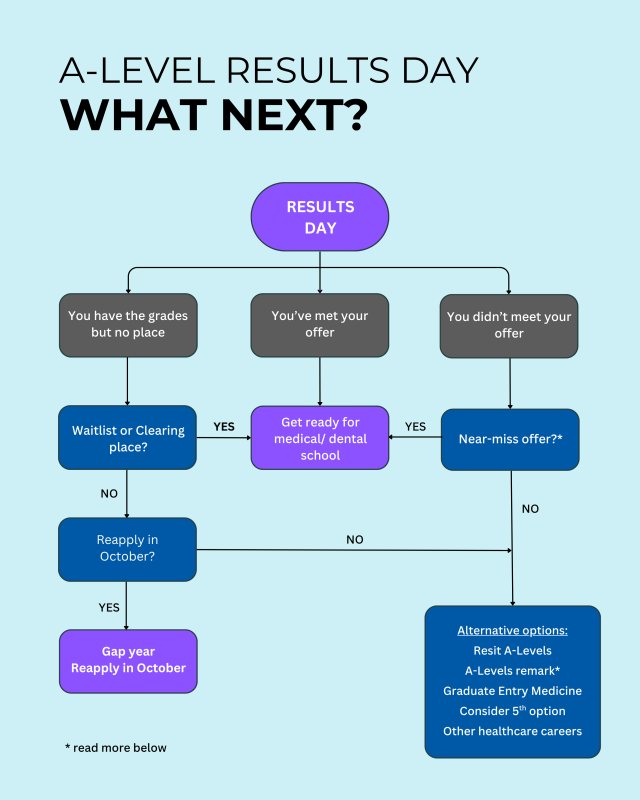
Congratulations to everyone who received their A-Level results today! Whether or not you received the grades you expected, you should be really proud of yourself for coming this far. Here’s what to do next if you want to study healthcare at university:
Near-miss offers
In rare cases, some universities might still accept you onto the course if you miss your offer grade by one, or two, grades. Not all universities offer this and you will be contacted if your place is eligible for a ‘near-miss’ offer.
A level re-mark
If you didn’t get the results you expected, you could ask for a re-mark (known as ‘review of marking’). Speak with your subject teacher if this is the right option for you. Remarking usually costs around £50 per exam and, if your new grade is lower, this will be final. Remarking doesn’t guarantee you’ll secure your uni place but you could re-apply next year with the grade(s) you receive.
Alternative options
Not getting the place you wanted doesn’t mean you can’t work in healthcare. You may want to comsider your fifth option subject, if you applied for a back up subject on your UCAS application. There are also many other subjects that allow you to have rewarding careers in healthcare for you to explore. Some students may also choose to re-apply as a graduate. If you choose this option, be sure to undertake a degree that is accepted by schools that offer this course, and remember it can be very competitve.
You have the grades but no place
If you managed to do better than expected, you have a few options you can try. Many schools use waitlists if a place becomes available, so make sure when completing your application you select any boxes that give schools the permission to do this. They’ll normally let you know beforehand if you have been waitlisted, so you know whether it’s an available option. You could also try to secure a place via UCAS Clearing but nite that not all medical or dental schools use this method. Alternatively, you could decide to take a Gap Year and reapply, this will give you time to build strong work experience, give you a breather after your studies and start afresh!
For the third largest healthcare profession in the UK, there are a surprising number of misconceptions held by the public about pharmacy. However, if you are thinking about pursuing a career in the field, you should be equipped with all the facts.
Myth: Pharmacy is all about dispensing medicines
Traditionally, dispensing has been a core role of the pharmacist. Nowadays, however, the extent to which dispensing features as part of a pharmacist’s role is highly varied. In recent years, pharmacists’ roles have become more clinical in focus.
In any typical day, pharmacists in patient facing roles will manage and monitor patients, review patients’ medicines, and develop clinical treatment plans with the wider healthcare team. Pharmacists now administer vaccinations, support patients in maintaining a healthy lifestyle and prescribe medicines.
Myth: Pharmacists can’t specialise
There are many opportunities for pharmacists in patient facing roles to specialise. Pharmacists can specialise in a range of clinical areas including diabetes, mental health, cancer care, minor ailments and urgent care. These specialist clinical roles reflect the increased complexity of medicines in the treatment of patients and the recognition of the importance of the role of the pharmacist by the NHS within healthcare.
As part of a multidisciplinary team which will include other healthcare professionals, pharmacists’ knowledge of medicines contributes to ensuring that patients receive the most appropriate medicines treatments, and that patients get the most benefit from the medicines they take. These pharmacists may be independent prescribers and will, like doctors, be able to prescribe for any condition within their clinical competence. Indeed, recently adopted pharmacy standards mean that in the near future, on completion of their degrees and foundation year, all new pharmacists will be independent prescribers.
Myth: Employment prospects for pharmacists are limited
This couldn’t be further from the truth! When I qualified there were four main career paths for pharmacists following registration: community, hospital, industry and academia.
In recent years, the offering has broadened in line with the pharmacist’s expanding role as a science-based clinical practitioner. Pharmacists are increasingly working as part of general practice teams, and there are exciting new roles for pharmacists in settings such as urgent and emergency care.
As a pharmacist, approximately 80% of your skills are transferable, and there is flexibility to combine several pharmacy roles through a ‘portfolio career’. Equally, pharmacists can work in other areas such as government, research, education, drug discovery, regulatory affairs, finance and the media.
Pharmacists are experts in medicines and their use for patient benefit. Their understanding of how to apply science to clinical situations enables them to make a unique contribution to patient care. If you want a career where the work is highly rewarding, where you can be challenged, have job security, and get an enormous sense of achievement from caring for other people by making a difference to their lives, then pharmacy may be for you. Don’t listen to the myths – get the facts.

About the author
This article was written by Professor Duncan Craig, Chair of the Pharmacy Schools Council (PhSC) and published in the New Scientist for Media Planet UK’s Careers in Science and Healthcare campaign. The campaign aims to showcase the exciting careers available in the science and healthcare sector and the variety and importance of these roles for the UK economy.