Top 10 Tips for International Students Coming to the UK to Study Dentistry or Dental Specialties
Choosing to study abroad can be both exciting and overwhelming. Understandably you may have a lot of questions on packing essentials, travel logistics, adapting to teaching styles and settling into life in the UK. I decided to gather expert advice by speaking to international colleagues at various stages in their dental journey (for example completing a gateway year, doing undergraduate dentistry or even postgraduate specialty training). I wanted to share what I have learned and hopefully make your transition smoother so you can focus on creating a home away from home.
Here is a compilation of top 10 tips for those of you planning to study dentistry or dental specialties in the UK.
1). Keep travel documents handy
Let’s start with admin. Travel documents are essential and often requested at the airport, university, when opening a bank account or registering with a GP (doctor). It is best to keep both digital and physical copies of crucial paperwork so go ahead and start printing. These include your passport, student visa, proof of finances, proof of accommodation, Certificate of Acceptance of Studies (CAS) statement, travel insurance policies and a list of emergency contacts. I would recommend keeping all documents in a waterproof folder in your hand luggage so that it is easily accessible when asked to present them.
2). Carry health essentials
Once again, you should keep both digital and physical copies of health records (vision, dental and medical including immunisation history and allergy lists), obtaining certified translations where necessary. Prescription medication should ideally be carried in hand luggage with correct labelling, original packaging and an accompanying medical note. Ensure you carry a sufficient supply to last until you can register with a local doctor considering potential travel delays and lost luggage. You may want to pack a small first-aid kit with pain relief tablets, plasters, antiseptic cream etc to have on hand whilst you are settling in.
Further guidance on travelling with medications can be found here:
https://travelhealthpro.org.uk/factsheet/43/medicines-abroad
https://www.gov.uk/take-medicine-in-or-out-uk
3). Dress for UK weather
UK weather is notoriously unpredictable so packing appropriate clothing is advised. Resist fitting your entire wardrobe instead sticking to versatile items you can mix and match. For colder months, layering is key so: t-shirts, jumpers, scarves, gloves and a cosy winter coat. For warm weather and heatwaves, stick to lightweight, cool and breathable fabrics. Everyday essentials are comfortable shoes, a waterproof jacket and sturdy umbrella. For gym sessions and joining sports clubs, pack activewear. For case presentations, networking events and university balls you may want to bring formal attire. As a healthcare student, you should refer to your university dress policy and pack suitable footwear for clinical settings. Rest assured, all the above can be purchased at local shops if you forget something or find luggage allowance restrictive.
4). Navigate public transport
Whilst walking is the popular student option for journeying around the city and campus, you may want to explore alternatives. This includes self-service cycle or e-bike hire for getting to classes, carpooling with friends to clinical placements or getting a bus for your weekly grocery shop. For longer journeys or daytrips, you can take trams, coaches or trains. Note that it is public courtesy to queue in a single-file line at bus stops and operate on a first-come, first-served basis making sure to let passengers off before boarding yourself. To save you learning the hard way, as your bus approaches, stand near the edge of the pavement so the driver can see you and hold your arm out straight to indicate that you wish to board. Additionally, on busy public transport systems like the London Underground (Tube), there is often signage stating to stand on the right and walk on the left. On arrival, you will quickly become accustomed to the British affinity for manners.
5). Recognise feelings of homesickness
First and foremost, be kind to yourself. You might catch yourself missing home even on the best days so having healthy coping strategies in place will help. I would recommend personalising your room and workspace with decorations, greenery and pictures of loved ones to build your own safe space. Try finding familiar ingredients from your culture at local international markets so you can whip up comfort meals. Schedule specific times to video call friends and family so you can stay connected whilst otherwise exploring everything your host city and community has to offer. By setting regular times for sleep, meals, study, exercise and socialising, you can build a routine that works for you and add structure to your time here. If you ever feel emotionally overwhelmed or in need of a listening ear, please do get in touch with the wellbeing services at your university which can provide professional support and advice.
6). Build your community
Finding your people starts with just a simple hello. Strike up a conversation with your flatmates, cook together or organise a movie night to get to know each other better. To meet more of your course mates, try sitting next to someone new in lectures, organise study groups or accept casual invitations to grab lunch together. Joining student-led societies is a great way to form friendships, develop interests or pick up new skills. You can research what is available on your union page, see what appeals to you at the freshers’ fair and attend taster sessions to try something new before committing to a membership. It takes courage to approach people so a friendly smile and small talk can go a long way.
7). Use academic resources
Whether you are starting or returning to university, you may face new academic challenges. You may find yourself needing extra help with literature searching, writing critically, referencing, data gathering and more. Do reach out to tutors and academic advisors who can direct you to appropriate library resources and study skills workshops. Your dental school may have a “buddy system” where incoming first-years are paired with second year students. If so, your peer mentor can offer practical advice on university life, managing workload, transitioning to clinics etc. If you are struggling with content, it is likely your peers are too. Support each other with the material, revisit content, explore relevant textbooks, organise study groups and direct questions to lecturers. Please remember to ask for help if you need it.
8). Start networking early
The best piece of advice I can offer is to get involved and say yes to opportunities. You will find that your university’s dental society will advertise and host speaker events, workshops, trade fairs etc. This allows you to connect with student colleagues, alumni and industry professionals, develop your clinical skills and knowledge and discover career pathways you may not have known or considered. Get in touch with the dedicated careers service at your university to seek expert advice on career planning, finding vacancies, writing CVs, sitting interviews and more. It is also worthwhile chatting to your lecturers and tutors about their journey beyond graduation. Each conversation can teach you, inspire you or allow you to help others reach their goals too!
9). Prepare for occupational challenges
It was only after a full day of working on phantom heads in the clinical skills labs or treating patients on clinics that I learned ergonomics really matters. Dentists frequently suffer from work-related musculoskeletal disorders, experiencing neck and back pain, shoulder tension, eye strain and more. That is why practicing healthy habits from the start like keeping a neutral posture, appropriate patient positioning, adequate lighting etc can make a big difference.
Also, as healthcare students you will be taught hand hygiene measures in line with Infection, Prevention and Control policies. I was surprised to learn the extent to which dental care professionals can suffer from occupational dermatoses and therefore the importance of prioritising hand skin care.
Do not worry if you are unfamiliar with either topic as you will receive detailed teaching on this from your dental school.
Further information can be found here:
https://dentistry.co.uk/2025/12/03/movement-matters-protecting-musculoskeletal-health-in-dentistry/
https://dermnetnz.org/topics/hand-care-for-healthcare-workers
10). Remember your WHY
You have already taken a brave step by choosing this course and moving to a new country so keep rooting for yourself. The mistakes you learn from, experiences you gain and people you meet will shape you into the person and clinician you become. As you explore the culture, history, landscapes and more- know that you belong here.
I hope you make the memories and find success in this new chapter of your life.
About the author
Amy is a third-year dental student at the University of Leeds. She is passionate about improving accessibility to opportunities and resources for underrepresented communities to pursue dentistry. She is often engaged in voluntary programs to deliver oral health advice in primary schools and mentor prospective dental applicants.
Writing or speaking about an experience is easy when you can simply list what you have done, state how it gave you some strengths, and how those strengths can be used in a medical setting as a future doctor. If we all did just this in our applications, all personal statements and Medicine interviews would be boring.
Reflection is also necessary for medical professionals as it is one of the best methods of learning in clinical settings: it’s the greatest building block in learning, which is why medical professionals are expected to be able to carry out this important process in not only medical circumstances but also daily life.
The art of reflection means we can blend actions with learning. Instead of simply listing your achievements, it is crucial to draw on those encounters, whether they are positive or negative, and show that you can learn from them. It is the constant and ever-growing relationship between the actions we take and the thoughts of reflection that allow us to learn effectively, especially in terms of learning from our mistakes.
Let’s discuss some examples!
Starting with a positive experience: you won the national football league during Sixth Form. Different attributes can be highlighted here, such as teamwork, communication skills, and determination. So, instead of focusing on the big picture of winning the league, you should delve into the skills you attained and strengthened. This can include learning how to strategise and collaborate with teammates and adapt your gameplay at different points of the matches.
Using an example of a negative experience may seem bizarre when you are trying to showcase yourself well, but it can be considered easier to reflect from a mistake or error than success. Say you lost the national football league. You can still demonstrate the same skillset as if you had won the league, but you can then add what you learned, points to consider for the future, and then link that with studying Medicine. For example, you could say that in hindsight, you realised that members of your team were not communicating well and were not assisting with each other’s weaknesses. You could also add that during future training sessions, you would endeavour to discuss match plans and weaknesses of all players so that you can fully maximise gameplay. And right there, you have turned a not-so positive event into a bonus outcome just by reflecting. Being mindful and learning from our mistakes is an essential practice in clinical settings as it enables us to learn through experience and mistakes, rather than through the standard textbooks or lectures.
Self-reflection is a big part of the Outcome for Graduates by the General Medical Council. This important process enables us to critique our actions, opinions, and behaviours. Reflecting on positive experiences can boost our confidence. Reflecting on negative experiences can demonstrate to yourself that you are actually learning and actively trying to improve. Reflection can also help medical professionals to think of innovative solutions to tasks and problems, as well as to cope with stressful and sophisticated situations, which are important in this growing profession. It is from this palette that we are then able to express our ideas and knowledge to carry out our duties and help patients.
So, ‘reflection’ does indeed have an abundance of meanings. To be able to look at yourself and examine your actions well means you need to dissect your actions with care and realistically accept your successes and wrongdoings. You have to learn from your experiences. Without moments of reflection, learning would be substandard and quite boring, especially in the clinical environment where bedside learning is an integral part of teaching. To show that you has the ability to reflect well demonstrates the growth mindset that Medical Schools are seeking and your willingness to learn and become a good future doctor.
Want to find out more about Reflection?
- General Medical Council Guidance on Reflective Practice
- NHS UK Foundation Programme Reflective Practice Toolkit
- The importance of good reflection: NHS England
- Medical Schools Council: guidance on reflection

About the author
Hi, I’m Alicia De Vidal, a third-year medical student at the University of Birmingham and the President of BWAMS (Birmingham Widening Access to Medical Sciences). I am interested in Cardiology, Paediatrics, and Forensic Pathology – which inspires my deep fascination for dissection and anatomy.
Take control of your next exam season by following these 5 top tips…
Exam season can very quickly become a train wreck: an endless to-do list, an overwhelming number of unwatched lectures, stress, and anxiety. It can all become a bit too much. We are only human after all.
But as exams are so common and an important component of higher education, we should get familiar with them. We learn from our experiences, carrying forward the skills and techniques that we find useful and adapting aspects that didn’t work so well. The problem is trial and error can sacrifice too many exam seasons before we can get it right. So how about I make it easier? After a lot of reflection, discussing with my peers, and trying different techniques, I’ve narrowed down my 5 top tips to help you ace your exams. Whether you are reading this blog as a student sitting your GCSEs, A-Levels, or end-of-semester exams at university, I hope that at least one of these tips helps you to feel a little more in control when exam season hits.
Know your exams
This will be different depending on your degree and modules but get familiar with your exam format. This might be multiple choice questions, short or extended answers or even an essay. Knowing what is expected of you means you can tailor your revision and also gives you some time to refine key skills that you need to develop to best sit your exams such as problem-solving and logically organising your ideas. It can also allow you to consider how you will manage your time e.g. how many minutes per question (if it is a timed exam). You can then use this as a brief guide to stay on track during your exam.
Make a plan… or sort of
I’ve never been one to stick to a detailed plan but nonetheless, without some sort of brain dump, my revision would be a mess. The great thing about planning is you can make it as detailed and specific as you want – but be realistic. I tend to list all the modules that I need to cover, split them into how many weeks of content there are and work backward from my exam dates, pencilling which modules I’ll cover when. Be nice to yourself. If I’m covering a hard topic in one module, I’ll revise an easier topic from another module on the same day. In this way, you spread out the difficult tasks whilst still giving you the much-needed ego boost to motivate yourself through the rest of the exam season! And finally, be flexible. Out of your daily to-do list, choose which topic you want to cover first. You’ll notice that you’ll gain more out of the session if you want to study rather than forcing yourself to. Make sure that you don’t avoid certain topics though just because you dislike them! If you don’t cover everything you want to do in a day (which will inevitably happen at some point) being flexible will allow you to adapt your schedule to make sure you cover everything you need to before your exam.
Choose your study space well (and who you study with)
Some people prefer a study buddy to keep them accountable, whilst others prefer learning through discussions in groups. Personally, I notice that I gain the most when I study by myself. This is because I can plan my time effectively to cover topics that I’m struggling on. It also gives more flexibility of where, when, and how long I study for. From experience, everyone has a different understanding of the content and different targets. This can make it challenging for everyone to reach their goals in a study session when everyone has gaps in their knowledge. But if group study is used as revision, this is often more effective as everyone has a good understanding of the subject, freeing the session to challenge each other and explore key concepts in detail. I also like to vary my surroundings, alternating between the campus library, different buildings on campus, public study spaces, and my bedroom. If you do decide to study in your bedroom, make sure to tidy it up first – take it from experience: A clear space really does mean a clear mind!
Prioritise your breaks
Our wellbeing often takes a hit during exam season, and if you are pulling an all nigher for an essay due the next morning, then arguably it’s ok to sacrifice the movie night you planned! But exam seasons are often a couple of weeks long, so consistent neglect can accumulate to become a huge hindrance to your physical and mental health as well as your performance in your exams. The key is to take regular breaks, and I don’t mean a 5 hr break binge-watching Suits (guilty…). I like to take the Pomodoro technique (find more information here) but adapt it to my own schedule e.g. 1.5 hr study session, 30-minute break. Make sure your breaks are away from your screen! Stretch, take a walk, or have a snack! This will keep you energised and your mind ready for the next study session. Make sure to pencil in time to catch up with your friends and family and do something fun! This can help to reset your mind and put exam season into perspective, preventing you from becoming overwhelmed.
Don’t compare yourself to others!
It’s human nature to see the world in a competitive light. Whilst this often motivates us to work hard, we often forget that we are our harshest critics. Everyone has their own way of learning. This includes your revision style, how much time you spend studying and how you organise your time. The key is to make sure that you are achieving your personal goals. Set some objectives e.g. learning a new concept or achieving a certain percentage in a mock exam and reflect on whether your current revision technique is allowing you to achieve this. If so, take note of what you did to remind yourself during the next exam season. If not, then it’s time to reconsider how you are studying!
So there we have it! 5 top tips to help you take control of your exams! Tried and tested by me and many other students, I can honestly say that they’ve really helped me stay focused and motivated during my exams. I hope this helps and good luck!

About the author
Hi, I’m Simrah, a third-year medical student at the University of Birmingham. I am interested in general practice, endocrinology, and medical education and have a passion for widening participation. I love to teach and currently tutor GCSE and A-level Maths. In my free time, I am a henna artist and love to watch law and crime dramas!
Supporting yourself during your studies can be necessary for some students to make up the difference between student loan and living costs. Juggling the demands of university and part-time work can be challenging but not impossible. Here’s my guide and tips for working alongside your studies.
Find a job that’s flexible
Look for roles that allows you to take shifts as and when you like them, such as agency work. I worked for an agency in hospitality during the earlier years of my degree and found it worked well given the changing timetable and demands of university work.
Try to find work that allows you to develop your dental/ medical professional skills
Dental nursing is a great part-time job for dental students as it allows you to observe procedures, work with dental materials and learn patient management skills. This is more accessible for those who have already been a dental nurse but some places take students as trainees, too.
Working in a dental technician lab also gives you a great opportunity to apply your dental knowledge and improve your manual dexterity. Working on dental-related projects gives you a chance to apply your dental knowledge – and the same goes for medicine.
Keep an eye out for opportunities sent to you by your dental or medical school which are specific for dental/ medical students.
Working as an intern at your university
Opportunities often arise for part-time work within your university. These can be great roles for students as the university usually offers flexible working hours since they know students have lots of commitments to manage.
Keep an eye out for roles within your dental or medical school for students to work as partners on projects. This allows you to utilise your expertise of the student experience and introduces you to the learning and teaching improvement processes.
Utilise the university’s Student Job hub
The university’s Student Job hub will have opportunities available to students and often these are jobs which have been selected due to their suitability to students. Here, you can also find internships both for term time and the summer.
You can also use the employability services at your university for support on CV, applications and test practice for roles.
Find evening or weekend work
Due to the demands of dental and medicine degrees, we often need to be available for university classes Monday – Friday, 9am – 5pm, so it’s a good idea to find a part-time role which won’t clash with any classes.
Reminder that all classes in dental and medical school will likely be mandatory and there are review meetings for students struggling to attend. It’s best not to jeopardise your studies by skipping classes to work.
Find remote work
Remote working offers a greater degree of flexibility than that of jobs where you’re required to work on a premise. It also reduces travel time and allows you to instead spend that time studying or working. Remote work can be done anywhere and usually is flexible hours, which would allow you to work on breaks between classes, too. Remote working also usually doesn’t require a uniform and can also save you money on buying specific clothes.
I hope these tips help you make informed choices about working part time during your studies. It can be challenging but many of us do it. Best of luck!
Written By Chelbi Hillan, Dental student at the University of Glasgow
Transitions can be daunting for most people, even more so as a care leaver who is entering dental school. I remember when I first considered applying to dental school, I was in S5 and went to take part in an access to dentistry summer school. As a young person still to find my confidence and power in my care experienced identity, attending the summer school made me feel like I couldn’t do it. The opportunity was great but I just remember feeling like “I don’t belong here”. I’m telling you this as imposter syndrome was probably one of the biggest barriers in front of me chasing my dreams to become a dentist. When I met people who spoke eloquently and boasted of their summer travels, I felt like I just wasn’t good enough to be there. This led to me leaving the summer school before it ended.
At this juncture in my life, I accepted I wasn’t going to be a dentist and pursued a career in immunology and microbiology. It wasn’t until after finishing my undergraduate and masters degree that I had the confidence to reapply. Even after becoming an accomplished young woman, still something about the prestigious reputation dentistry holds made me nervous and the feelings of self doubt returned. It takes a lot of mental reprogramming and self assurance to beat the negative thoughts and affirm that I am good enough to be on the course.
As a care experienced person applying to dentistry, the widening access team are one of the best resources you can utilise. From the moment I applied, I reached out to the team to ask for support and had a 1-1 with someone to talk about adjusted offers, money and tuition fees. The widening access team helped liaise with the dental admissions team to secure an adjusted offer, without this I wouldn’t have been able to get into dental school. Adjusted offers are not making allowances, they are offered to students who face significantly more challenge than their peers and therefore have greater difficulty in preparing for tests and applications. Adjusted offers are nothing to be ashamed of, they are made in order to recruit exceptional students in extenuating circumstances. If you are worried about people knowing you had an adjusted offer, nobody except the admissions team and widening access will have knowledge of this.
Once I received my adjustment, I was then invited to interview and offered a place on the course. I was overjoyed that after years of studying biomedical sciences, I was finally going to study dentistry. A dream come true. That is until I realised I had no money and I was unsure if I would get funding for a second degree. I had another call with the widening access team who explained the scholarships they could offer me and provided information about how to apply for the discretionary fund (care experience is a priority group at my university). This went a really long way in helping cover the costs as an independent student. If you are studying in Scotland, we have the Dental Student Support Grant (DSSG) available from second year onwards and is issued by the Scottish Government with a commitment to wok for the NHS for one year for each year the grant is awarded.
Social housing was another lifeline for me as a student studying in Glasgow city. Rent prices had increased exponentially in the city as I was about to start my degree and the house I was living was going to increase the rent by 50% just months before I was supposed to start my degree. Due to this I had to move back to my hometown and commute for a few months at the start of my degree. Thankfully, my application for social housing was accepted three months not the course and I was able to move close to the university again and this time with sustainable rent prices. Truly, if I didn’t get access to social housing it would have been impossible for me to live alone in the city so I would really encourage you to apply to registers and contact housing associations to ask if they have priority places for care leavers. If you can’t access social housing, some universities have 12 month accommodation available for care leavers and will help accommodate you moving in earlier if necessary. If you are stuck for housing, liasing with the widening access and accommodation teams can allow them to support you into suitable and sustainable accommodation.
Building strong connections during my dentistry degree was undoubtedly one of the reasons I was able to endure and push through hose hard days. Dentistry is an extremely rewarding career but its no secret that often dental professionals are burnt out. As care leavers, we may have less support than our peers so it is important you find people to fall back on when times get tough. I was lucky to find some like minded friends on my course and their unwavering support has carried me through educational and personal challenges which arose during my studies. As care leavers, we can be hyper independent as this was how we survived sometimes but relying on others allows you not only to survive but to thrive.
Another resource I have utilised many times in my education is the university counselling and support services. Many of us have complex mental health challenges and although the university counselling tends to be limited to a set amount of sessions, it was invaluable for me in times of crisis. They offer a range of services from group sessions to 1-1 counselling. Having knowledge of what is available and how to access it is important. Even if you don’t use it right away, it is good to know what is on offer for when you might need it.
Student societies can be a great way to meet other students and build a network of support. Universities have so many societies meaning there is something for everyone and even if you can’t find one you like then you can start one. Some universities even have care experienced and estranged student societies or events so look out for these. Meeting other care experienced students at university was one of the most healing experiences for me and prevented me feeling so isolated in the challenging times.
My final piece of advice is that all you have endured in your time will help you relate better to patients. Often, I find myself more able than my peers to empathise with patients about their situation. I think that having experienced many challenges in my early life as a child and young adult has made me more aware of the social factors which influence oral and systemic health. Having this deep understanding allows me to connect with patients and provide care for them through this lens of understanding.
Written by Chelbi Hillan, Dental student at the University of Glasgow
The Dental Schools Council spoke to Admissions Leads across the UK on what makes a good dental students. Here are the highlights and summaries of what universities look for in prospective students, including tips on work experience and UCAT.
You can watch the full webinar here.
What’s a key skill Admissions Teams look for in prospective students?
Professor Chris Pennington, University of Newcastle
We’re looking for people that can reflect. It’s really important that these are questions in your mind when you’re doing that. When you observe or volunteer, ask yourself: What would be challenging about that role? What would help me handle it? How do my skills fit, and what would I need to develop? Reflection like that really stands out.
Juliet Kendall, University of Manchester
It’s not just about picking out those academic high-flyers. We’re looking for softer skills – empathy, resilience, compassion – the values that make someone a good dentist. Applicants need to show reflection and awareness of their own strengths and areas to develop.
What work experience do dental schools look for?
Professor Chris Pennington, University of Newcastle
We used to call it ‘work experience’ but what matters is career exploration – understanding what the profession involves, both the good parts and the hard parts. We want applicants who have thought about what suits them and what might be challenging.
Professor Chris Pennington, University of Newcastle
You want lots of experience of human interaction. Jobs like waiting tables or tutoring give real transferable skills, such as teamwork, handling complaints and communication. We look for applicants who recognise that.
What are alternatives to clinical work experience?
Professor Chris Pennington, University of Newcastle
We no longer reward prestigious work experience as we know some people find it far easier to secure that work experience. There are other alternatives as well. A wonderful course is Sheffield’s Discover Dentistry course. You can also listen to podcasts, articles, talk to people in healthcare and read up trusted online content. There are many ways to explore the career.
When do students start to have practical, hands-on experience?
Ewen McColl, University of Plymouth
Students are very practically involved from early on. They’ll need to use their skills in an environment with patients who sometimes struggle to access dental care. In our school, students work across the South West – in community clinics and hospitals – and it’s not unusual for them to treat a child who needs multiple extractions under general anaesthetic. It’s real hands-on learning from the start.
What’s a recent success of a dental student supporting patients?
Ewen McColl, University of Plymouth
One of our students picked up signs of oral cancer in a patient – a squamous cell carcinoma. Dentistry is about understanding biology and pathology and applying it to real lives.
What’s your advice for managing nerves at an interview?
Professor Chris Pennington, University of Newcastle
Everyone’s nervous at interview. We don’t penalise that. If you need to pause, take a sip of water, ask to repeat the question – that’s fine. We expect nerves.
UCAT explained
Juliet Kendall, University of Manchester
Ultimately, UCAT is a test people have to practise. You can’t really study for it but you can practise. All the info is available on the UCAT website. There are lots of resources there. Universities are looking for people with empathy, resilience, compassion, we hope the test picks out some of these skills.
Why do dental schools value diversity in their cohorts?
Professor Chris Pennington, University of Newcastle
As dental professionals, we serve people from all communities and all backgrounds. We need to know how best to meet their needs, including the ones we might not even see yet.
Having students from varied backgrounds gives us new perspectives, helps us solve complex problems and makes us stronger as a profession. For example, after Black Lives Matter, some of our black students pointed out that we had no images of healthy black gums in our teaching. We hadn’t realised that gap until they raised it and it led us to change our curriculum.
People who come from less well-represented groups bring insights into their own communities, highlight what we’re missing and help us care better for everyone.
You can watch the full webinar on the Medical Schools Council YouTube channel.
A strategic application is one of the most important ways to maximise your chances of getting into medical or dental school. Having a perfect application isn’t necessary – where you apply to can matter more. Many students miss out on a place in medical school not because they didn’t do well enough in their exams or the UCAT but because they didn’t apply strategically and use their strengths to their advantage.
What does a strategic application mean?
Medical schools select candidates for interview based on:
- Predicted A-Level grades
- GCSE results
- UCAT score
- Sometimes, your personal statement
Medicine and Dentistry are highly competitive and not every applicant is top-performing in all areas. Fortunately, different universities prioritise different factors. This means you can apply to the schools that suit your application the best.
Top tips for strategic application
- Check widening participation (WP) points: If you qualify, explore universities that award WP points when reviewing applications.
- Meet the A-Level requirements: Some universities require A*AA, others AAA and this can vary for Graduate Entry Medicine. Check which universities match your expected or actual grades.
- Understand your strengths and weaknesses: Know where your application shines and where it doesn’t. If you have strong grades, look at universities that require this. If you did lots of work experience that developed key skills, reflect on these in your personal statement.
- Research each university’s process: Make sure to understand how different universities’ run their application process, e.g. the types of interviews they hold.
- Attend applicant open days: These provide direct insight into a university and you have to chance to ask advice from admissions teams and current students.*
- Consider all universities: Go through every medical university as some you might not have considered properly may end up becoming your first choice. Use The Medical School Council’s entry requirements tool.
First, identify your strengths and weaknesses. Then, choose universities that align with your strengths. Take your time. Don’t leave your application until last minute. It can seem overwhelming and daunting but it’s worth spending time thinking carefully. This decision can make or break your chances!
Strategy for narrowing down options
- Make a list of all UK medical schools that you meet the requirements for – use the Medical School Council’s entry requirements tool.
- Cross off universities where you don’t meet the UCAT cut-offs, if the university publishes these.
- Highlight the universities that value your strongest areas. I would advise you to look specifically on the websites of each university and published information for specific information on how they mark applicants.
- Consider non-academic factors, such as city, location, teaching style and opportunities for placements. Make sure you would enjoy the course you’re applying for.
Structuring your four UCAS choices
1st choice: A slightly risky option
You can afford to have an ambitious choice that’s still within your reach. This is a university you’d be excited to study at and willing to potentially risk a rejection. However, this still has to be in the scope of your capabilities.
Example: My weakness was my UCAT score – applying to Norwich medical school was risky for me because they didn’t have a cutoff and were more competitive than the other universities I applied to.
One risk is okay as long as the options are well thought-out and proportional to your own stats (an ambitious choice doesn’t look the same to everyone, depending on your grades and UCAT).
Note: The “competitiveness” of a university can be estimated by researching the applicant to offer ratio online.
2nd and 3rd choice: Two solid options
The 2nd and 3rd options are universities which you’ll have a very good chance of succeeding at. They match your strengths, they aren’t as competitive but they’re also places you would be happy going to.
Example: my 2nd and 3rd options were Queens university Belfast and Keele University. Belfast strongly valued good GCSEs and previous experience in the interview and Keele valued a strong personal statement, which I also had.
You may also find it useful to analyse previous UCAT score trends to try to ‘predict’ the cutoff if a university hasn’t declared one. But make sure you fall well within the predicted range if you are using this strategy as requirements can change yearly. Some universities publish their past admissions statistics on their websites and it’s also possible to analyse the scores of previous applicants from websites such as The Student Room – but use this with caution as the advice doesn’t come directly from universities).
4th choice: The backup
It’s possible not to receive offers from any of the other universities, so you need a safe option that you know you’re most likely to get into. This is the university that most strongly lines up with your strengths and it may also be much less competitive. This may not be a place you would be thrilled to study at but, given the option between the chance to study Medicine/ Dentistry and not, you would seize the opportunity.
Example: My backup option was one of the newer medical schools and my application looked extremely strong as they gave a scoring system to predict our likelihood of getting an interview. Even though I wasn’t that passionate about the city of the university, I knew I needed a safe option in case the other applications failed.
But how do you know specifically which medical schools to apply to?
It depends on your stats! The most valuable thing you can do is to look at the weighting and marking criteria that the universities use to score their applicants. You want to apply to the universities that favour the strengths you have!
But what if I don’t have my UCAT score yet?
If you’re thinking ahead of which universities to apply to, I would start visiting universities and going to open days. You can find a list on the Studying Healthcare Events page, as well as the Instagram and TikTok accounts. You get a ‘vibe’ from the city as to whether you would be happy there when you visit and loving the city you study in definitely enhances your university experience.
Make sure to keep an open mind. Before taking my UCAT, I was set on going to London or Sheffield and I was so when I realised that they were too competitive for me! The bottom line is to learn about different universities and possible options, research less competitive universities to keep an open mind and try to identify which areas of your application may be weaker early on.
Summary
- Don’t rush your choices – they could make or break whether you get a place to study Medicine or Dentistry.
- Evaluate the strengths in your application and find the universities which best compliment this.
- Don’t think about prestige too much. Medicine and Dentistry aren’t the same as applying to other degrees and you might have to apply to places much less known – but it gets you to be a doctor pr dentist the same!
- Remember that you’ll find the place you’re meant to study in and taking a gap year or resiting exams is more common than you might think!
*Applicant open days: Open days were invaluable for me. At Keele, the Admissions Lead explained exactly what they look for in a personal statement, which helped me secure an offer. At Lincoln, I spoke to the admissions officer about their scoring system, which reassured me that I was a strong applicant. Open days can also help when deciding which offer to firm.
Written by Beth Stephenson, 2nd Year Medicine student at Queen’s University Belfast
Don’t underestimate your fifth choice on your UCAS application. It’s your safety net if things don’t go to plan, even if you intend to reapply the following year. But how do you decide which course to choose alongside your four medicine or dentistry applications?
Stategies that worked for me
Strategy 1: Pick a science-related course
This is a good option if you are more interested in the science behind medicine or dentistry, and particularly enjoyed studying Biology or Chemistry at A-Level. It particularly suits students who are more research-minded.
Examples: biomedicine, pharmacy biochemistry, biology, chemistry
Strategy 2: Pick a healthcare-related course
Choose this if you are more drawn to patient interaction and the caring side of medicine or densitry. If you have enjoyed first aid or pre-hospital care, courses such as Paramedic Science could be especially appealing.
Examples: nursing, midwifery, paramedic science
Strategy 3: Choose a degree linked to a medical speciality
For example, if you are fascinated by neurology, you could apply for Neuroscience. Other examples included genetics, immunology, psychology, physiology, anatomy. This pathways works well if you already have a particular area of medicine in mind.
Strategy 4: Pick a completely unrelated course
This is a good choice if you have a strong passion outside of medicine or dentistry and would genuinely enjoy studying it further. For example, you might apply for languages, humanities subjects or non-medical STEM degrees. Some applicants can only see themselves doing medicine or something entirely different.
Transfer schemes and postgraduate medicine/ dentistry
If you’re not willing to take a year out to reapply to Medicine or Dentistry, you could choose a course which is most likely to allow you to either switch to Medicine or Dentistry, or join as a postgrad.
Transfer schemes
Some universities allow students on degrees such as biomedical science, biomed, optometry, pharmacology, neuroscience and similar to transfer into Medicine after one to three years, depending on performance. These are highly competitive and usually require excellent grades and attendance.
Postgraduate options
Another route is applying after completing a different degree. To be eligible, you normally need at least a 2:1 classification in your degree. Some graduate entry courses require science-related degrees, while others accept any subject. Instead of the UCAT, you may need to sit the GAMSAT. Graduate entry courses take four years; however, they are competitive and have limited spaces available. You can also apply to standard five-year courses as a graduate. Requirements vary – some universities still ask for A levels in chemistry and biology, while others do not.
There is also the possibility of becoming a physician associate (PA) after a life sciences or health-related degree. It then requires a 2 year postgraduate PA course to be able to work under the supervision of doctors in the NHS.
Key takeaways
- Always put down a fifth choice, even if you think you will reapply. If you don’t receive a Medicine or Dentistry offer, you may be grateful for an alternative pathway in case you change your mind.
- There are multiple ways into the profession and many people study a different degree before becoming a doctor or dentistry.
Written by Beth Stephenson, 2nd Year Medicine student at Queen’s University Belfast
Congratulations to everyone who received their A-Level results today! Whether or not you received the grades you expected, you should be really proud of yourself for coming this far. Here’s what to do next if you want to study healthcare at university:
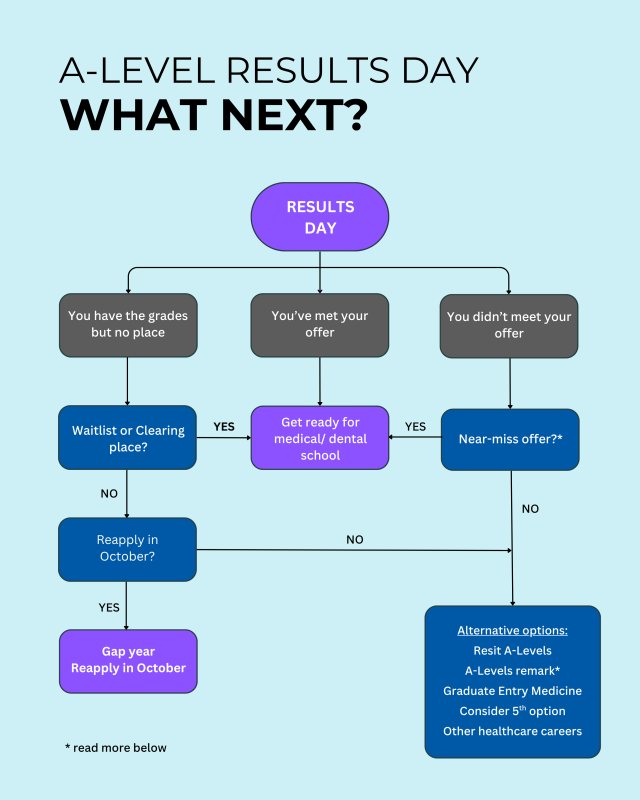
Near-miss offers
In rare cases, some universities might still accept you onto the course if you miss your offer grade by one, or two, grades. Not all universities offer this and you will be contacted if your place is eligible for a ‘near-miss’ offer.
A level re-mark
If you didn’t get the results you expected, you could ask for a re-mark (known as ‘review of marking’). Speak with your subject teacher if this is the right option for you. Remarking usually costs around £50 per exam and, if your new grade is lower, this will be final. Remarking doesn’t guarantee you’ll secure your uni place but you could re-apply next year with the grade(s) you receive.
Alternative options
Not getting the place you wanted doesn’t mean you can’t work in healthcare. You may want to comsider your fifth option subject, if you applied for a back up subject on your UCAS application. There are also many other subjects that allow you to have rewarding careers in healthcare for you to explore. Some students may also choose to re-apply as a graduate. If you choose this option, be sure to undertake a degree that is accepted by schools that offer this course, and remember it can be very competitve.
You have the grades but no place
If you managed to do better than expected, you have a few options you can try. Many schools use waitlists if a place becomes available, so make sure when completing your application you select any boxes that give schools the permission to do this. They’ll normally let you know beforehand if you have been waitlisted, so you know whether it’s an available option. You could also try to secure a place via UCAS Clearing but nite that not all medical or dental schools use this method. Alternatively, you could decide to take a Gap Year and reapply, this will give you time to build strong work experience, give you a breather after your studies and start afresh!
Reflecting on why I chose dentistry, I had always been interested in a career that combined science with patient care. While dentistry and medicine initially appealed to me, I found that the hands on nature and continuity of care in dentistry aligned more closely with my interests. I was especially motivated by the opportunity to build long term rapport with patients and make a lasting impact on their oral health and confidence.
One of the most rewarding aspects of the course was the early opportunity to work with patients in a clinical setting. This experience was invaluable in allowing me to further develop my communication skills while applying theoretical knowledge in practice and refining my manual dexterity to grow in confidence as a clinician. Building trust with anxious patients and helping them feel more comfortable was a particularly fulfilling part of my training.
One of the key skills which required implementation during the course was managing time effectively. Unlike many other degrees, dentistry requires balancing academic study with clinical responsibilities. While the workload can be quite heavy at times, with effective organisational skills, it can certainly be managed. I would recommend a planner to help prioritise tasks appropriately and stay on top of commitments. Ongoing self reflection throughout the course is paramount not only as a student but as you begin your professional career post-graduation.
For anyone considering dentistry, I strongly recommend gaining as much experience in the field as possible, through shadowing professionals, speaking with current students and reflecting on your motivations. Dentistry is an incredibly rewarding profession and those of us in the field are very privileged to be in a position to help others in such a meaningful way.
For guidance on what studying dentistry at uni is like and everything you need for your application, use our resources here.

About the author
My name is Youssef El-Wahab and I have recently graduated from King’s College London with a degree in dentistry.